Leibniz.
Loading...
Teacher guide · Tasks

Make a PDF worksheet in minutes

Choose the exact content and difficulty you need, review every question, then turn the finished task into a printable worksheet.

In this article

01Before you start

A quick worksheet is a normal Leibniz task that you shape, check, and then download as a questions PDF.

Use a desktop or laptop and allow about five minutes for a short worksheet. You will choose from the existing question bank—this flow does not ask an AI to write a paper from scratch. Your finished task can still be completed online, but this guide follows the printable path.

  • Know the year level and course you are teaching.
  • Have a topic, subtopic, or set of syllabus dot points in mind.
  • Decide roughly how many marks or questions you want.
Key idea
Narrow filters give you a more focused worksheet. If Leibniz cannot find enough matching questions, broaden a dot point, difficulty band, or question-type filter.

02Open Tasks and start a worksheet

Open Tasks from the book icon in the left navigation, then choose New Task. Leibniz opens the task builder and keeps a live summary of your choices on the right.
Do this
Go to Tasks → New Task. If you are teaching from a class, you can also open that class’s Tasks tab and start there.
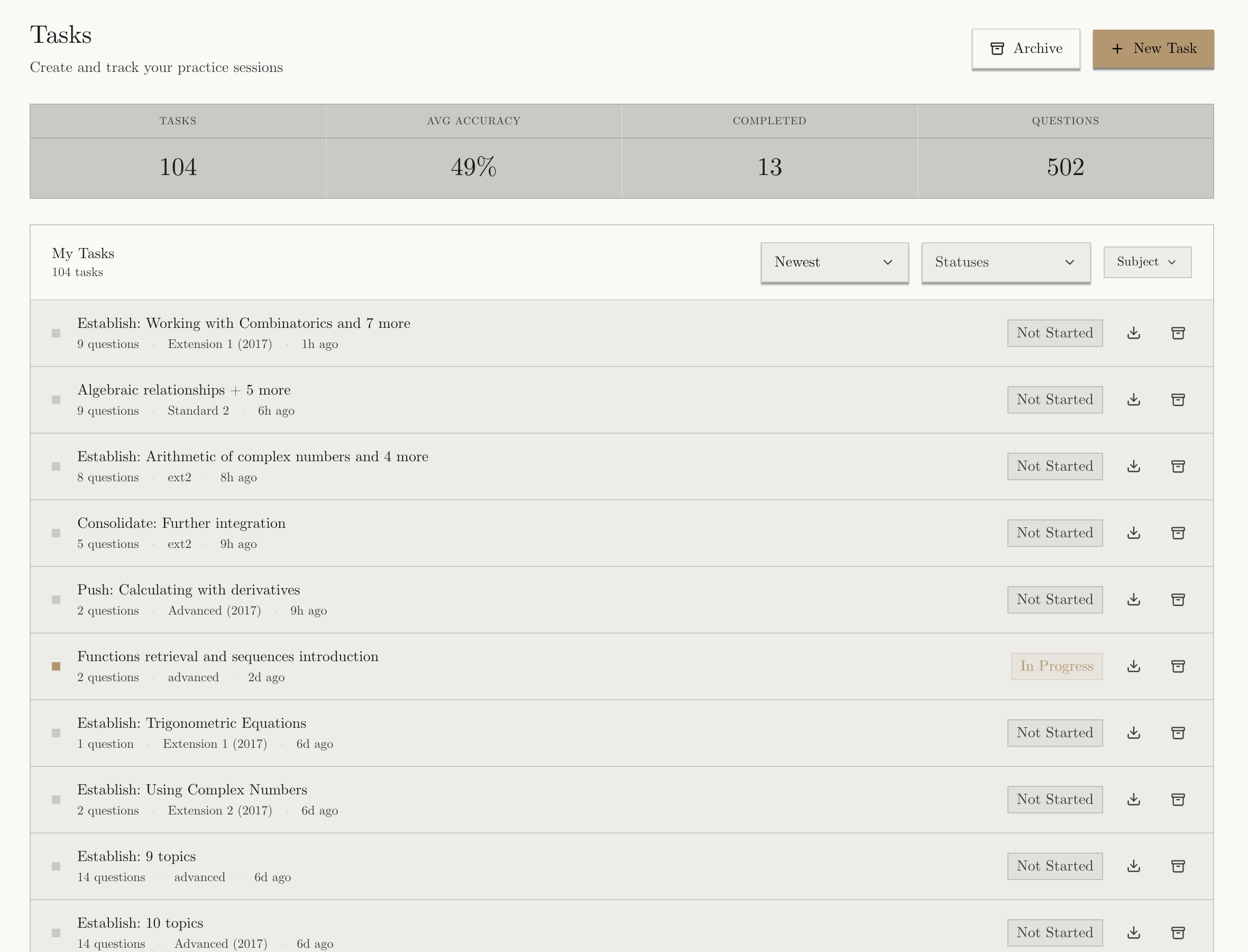
Light-mode Tasks page with the New Task button, task totals, and existing worksheet rows
Fig. 1. The Tasks page. Choose New Task in the top-right to open the worksheet builder.

03Choose exactly what to cover

Work down the left rail. Each choice unlocks the next level of detail.

1

Choose the year level

Select Year 11, Year 12, or both. This keeps the available courses and question bank aligned to what your students have been taught.
2

Choose the course

Pick the course used by the class. Check the syllabus year in the course name when both current and older syllabuses are available.
3

Choose topics and subtopics

A topic gives Leibniz a broad pool. Select subtopics when the worksheet should stay inside a particular lesson or unit.
4

Use dot points only when you need precision
Dot Points becomes available after a subtopic is selected. Choose one or several outcomes for a tightly targeted worksheet; otherwise leave this level broad.
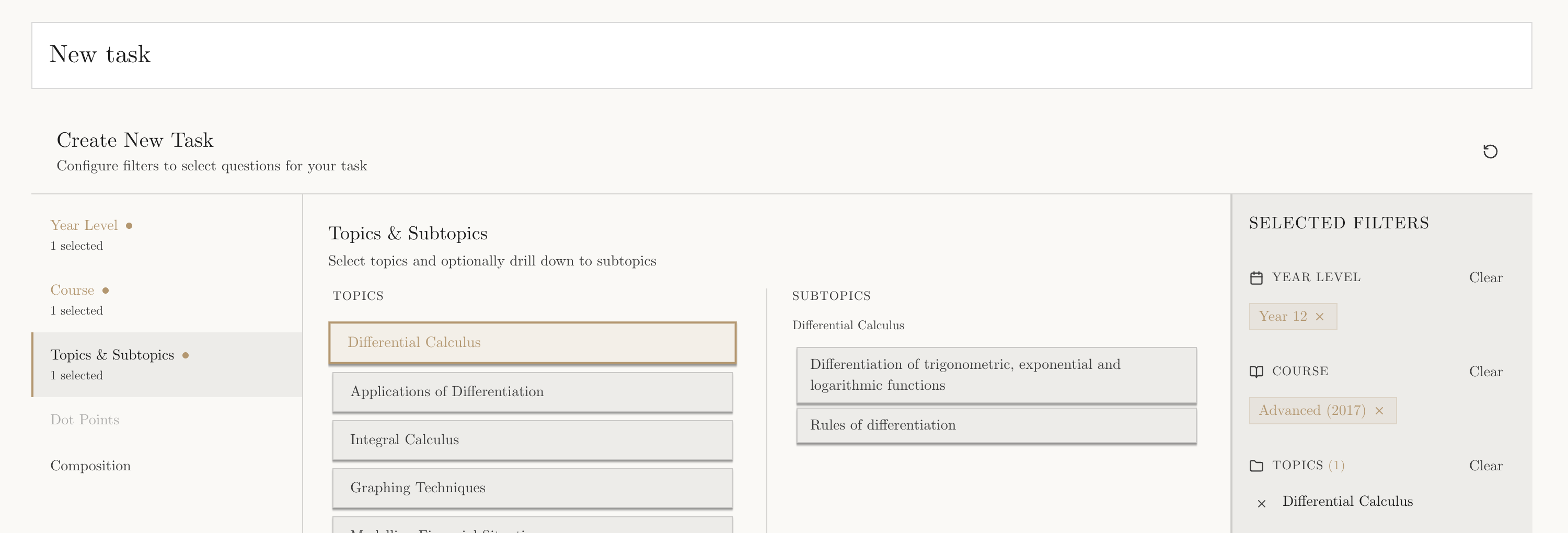
Light-mode worksheet builder showing Year Level, Course, Topics and Subtopics, and the selected filters summary
Fig. 2. A Year 12 Advanced worksheet narrowed to Differential Calculus. The selected filters stay visible on the right while Topics and Subtopics are chosen in the centre.

04Set the length and balance

Open Composition. This is the last builder panel and it controls four things: length, coverage, difficulty, and question type.

1

Pick marks or questions

Use Marks for an exam-like worksheet with a target total. Use Questions when the exact item count matters more. The estimate below the control helps you judge working time.
2

Check topic coverage

By default, selected content is shared evenly. Adjust the coverage mix only if one topic should carry more of the worksheet.
3

Set the difficulty spread

Drag the four-band allocation from Foundation through Extension. A band at zero is excluded; equal shares produce a broad mixed worksheet.
4

Choose question types

Restrict the task to written or multiple-choice questions, and choose calculator modes where the selected curriculum supports them. Leave these open for the largest, most varied pool.
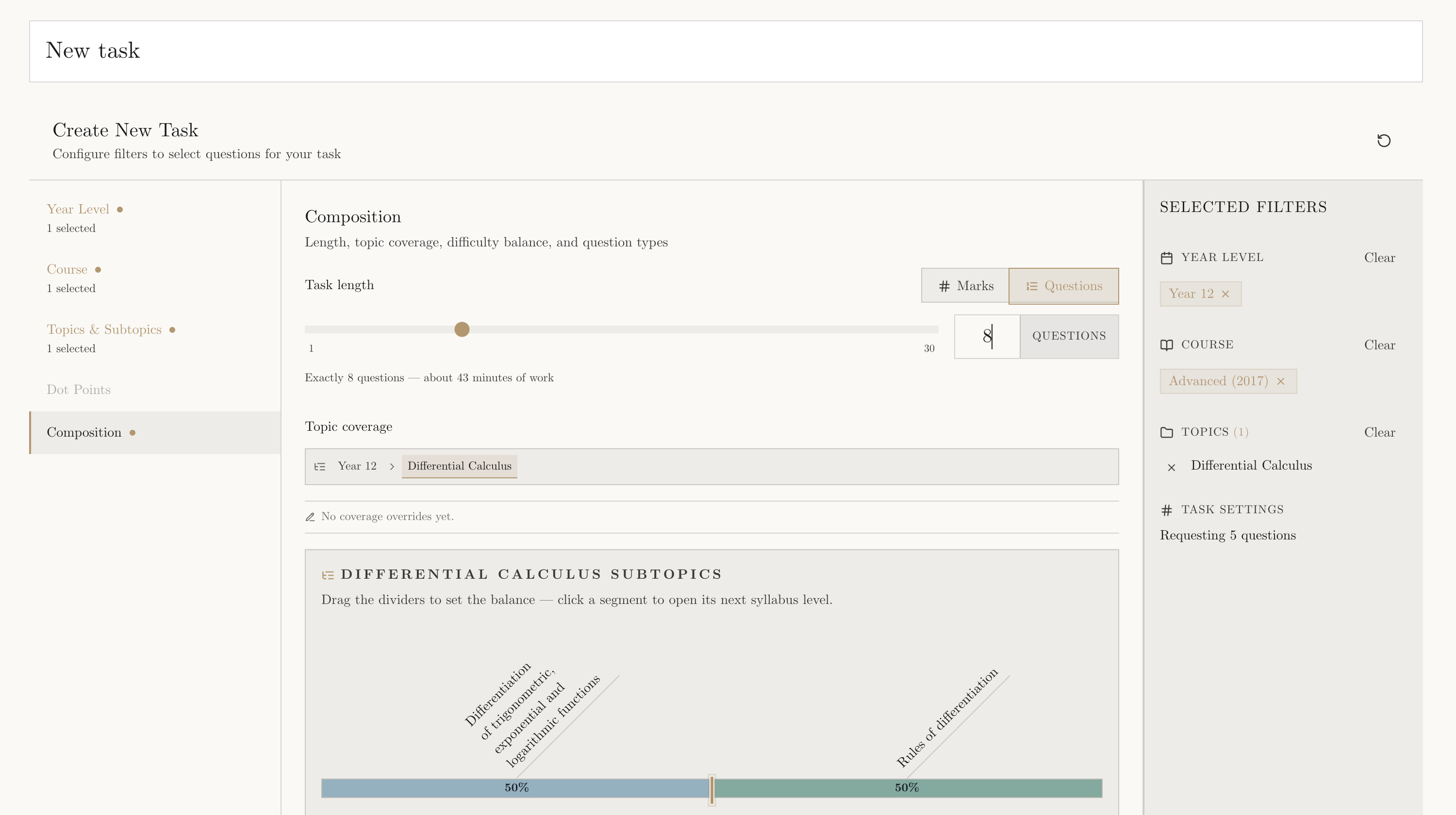
Light-mode worksheet Composition panel with Questions selected, an eight-question length, topic coverage, and selected filters
Fig. 3. Composition is one panel: choose marks or questions, set the exact length, then review topic coverage, difficulty, and question type further down the page.
Do this
Read the selection summary, then choose Compile task. If the available question count is too small, broaden one filter rather than repeatedly pressing Compile.

05Review every question

Compiling makes a draft. Nothing is assigned or saved as a task until you approve it.

Give the worksheet a clear title and check the due date. Expand each question and read the stem, marks, diagrams, and answer choices. The question and mark totals at the top should match the lesson you planned.

1

Swap a question

Use the circular-arrow Replace control beside a question. Leibniz looks for a different question that matches the same task criteria.
2

Remove or add

Delete anything you do not want. Use Add Question to choose a topic, subtopic, and difficulty for one extra item.
3

Approve the draft

When the order and total are right, choose Set Task. You will return to Tasks with the worksheet saved.
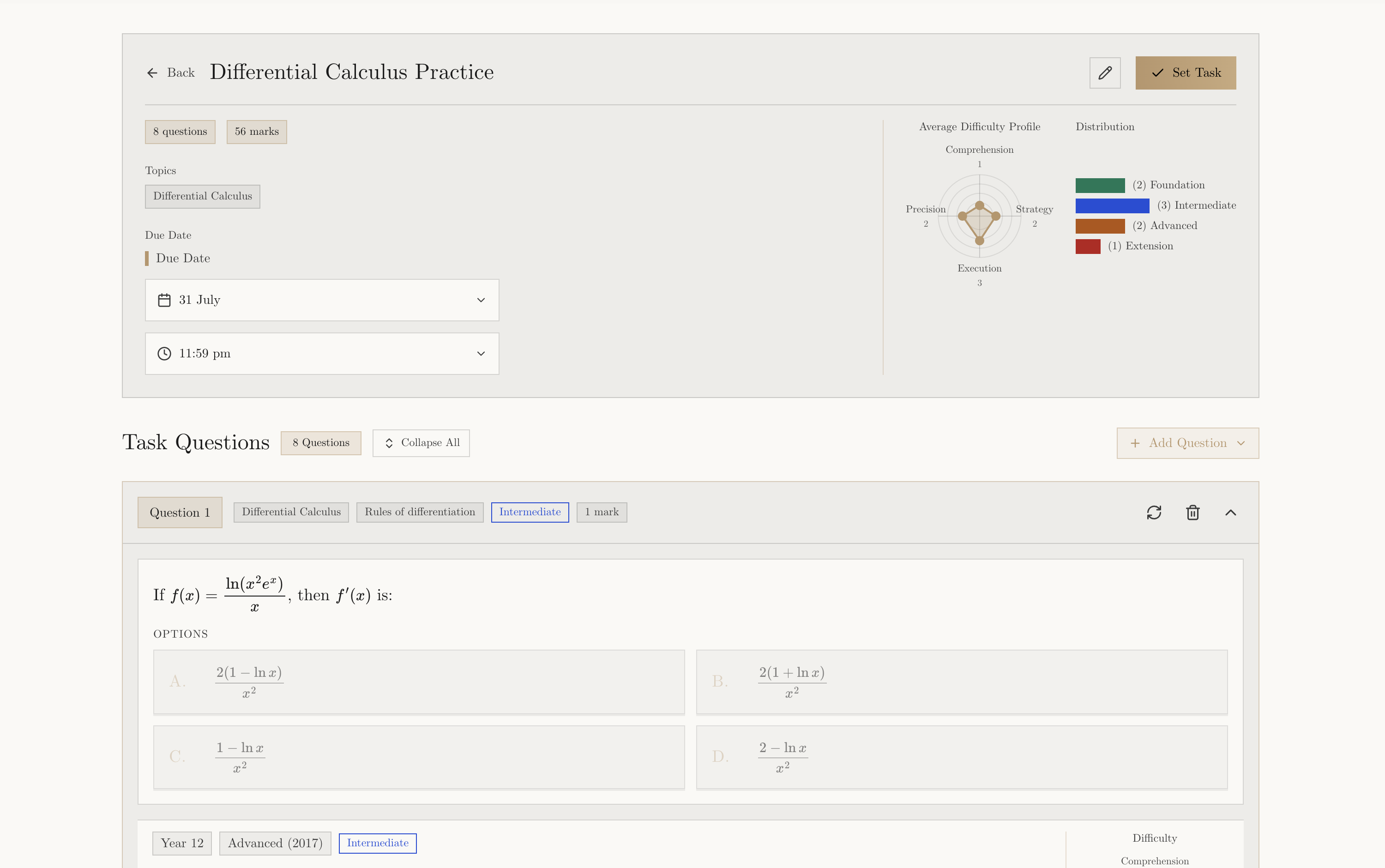
Light-mode compiled worksheet review with Set Task, due date, difficulty profile, Add Question, Replace, and Remove controls
Fig. 4. The compiled draft shows its title, total marks, due date, difficulty profile, and every question. Use the circular arrow to replace, the bin to remove, or Add Question to extend the draft.

06Download the PDF

Find the task in Tasks. Open its download menu and choose Questions. Leibniz prepares the printable worksheet and your browser saves the PDF.

Do this
In the task row, choose Download → Questions.

The Solutions PDF stays unavailable until the task is completed. This prevents the marking guide being handed out with a live online task by accident.
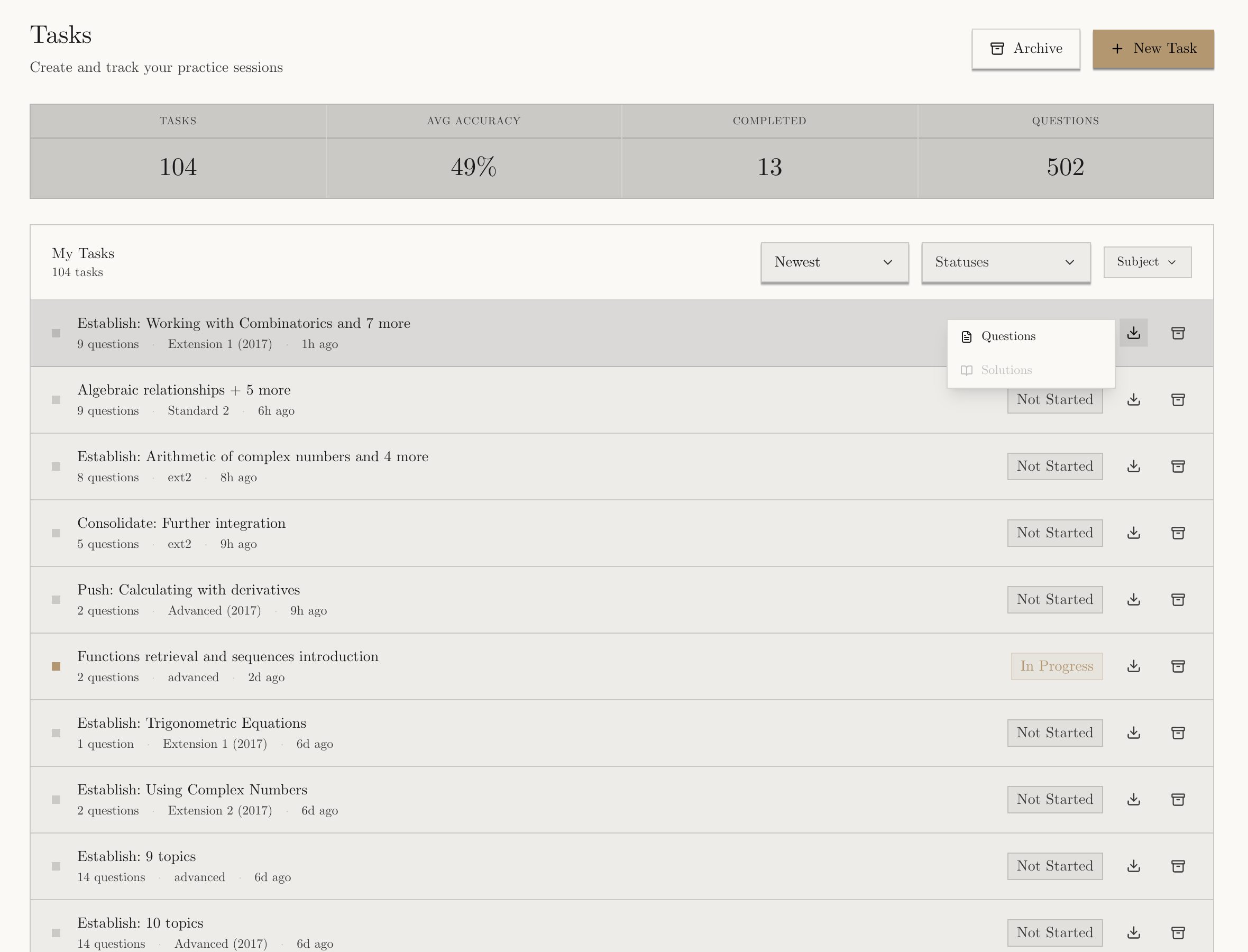
Light-mode Tasks page with the Download menu open and Questions available while Solutions is disabled
Fig. 5. Open the download icon in the task row, then choose Questions. Solutions remains disabled until the task is completed.
  • Open the PDF and check every page before printing.
  • Confirm diagrams, tables, marks, and page breaks look right.
  • Print the questions PDF; keep the solutions PDF for marking later.